Viral anatomy: the science behind "Brow Blindness".
If you’ve scrolled through social media recently, you’ve likely encountered the phenomenon of "Brow Blindness."
It usually involves a user looking back at a photo of themselves from three or four years ago—often sporting thick, dark, blocky laminated brows—and asking: "How did I not see that this looked bad?"
It is a moment of collective realization. We are waking up to the fact that for years, we have been prioritizing trends over our own faces. But why does "Brow Blindness" happen in the first place? And how do we ensure we aren't suffering from it right now?
The "exposure" trap
Psychologically, this is known as the Mere Exposure Effect. When a specific aesthetic (like the fluffy, vertical brow) saturates our visual feed—appearing on celebrities, influencers, and filters—our brain begins to recalibrate its definition of "normal."
We stop seeing the individual face, and we start seeing the trend. We lose the ability to judge objective harmony because our perception has been warped by repetition. We force a shape onto our features simply because we see it everywhere else.
The structural mismatch
The core issue of Brow Blindness is a disconnect between the brow and the bone.
A heavy, straight brow might look harmonious on a face with a strong, square jawline and high density. But paste that same brow onto a face with delicate, soft features, and it becomes overwhelming.
"Blindness" occurs when we focus on the brow in isolation, ignoring the architectural reality of the face underneath it.
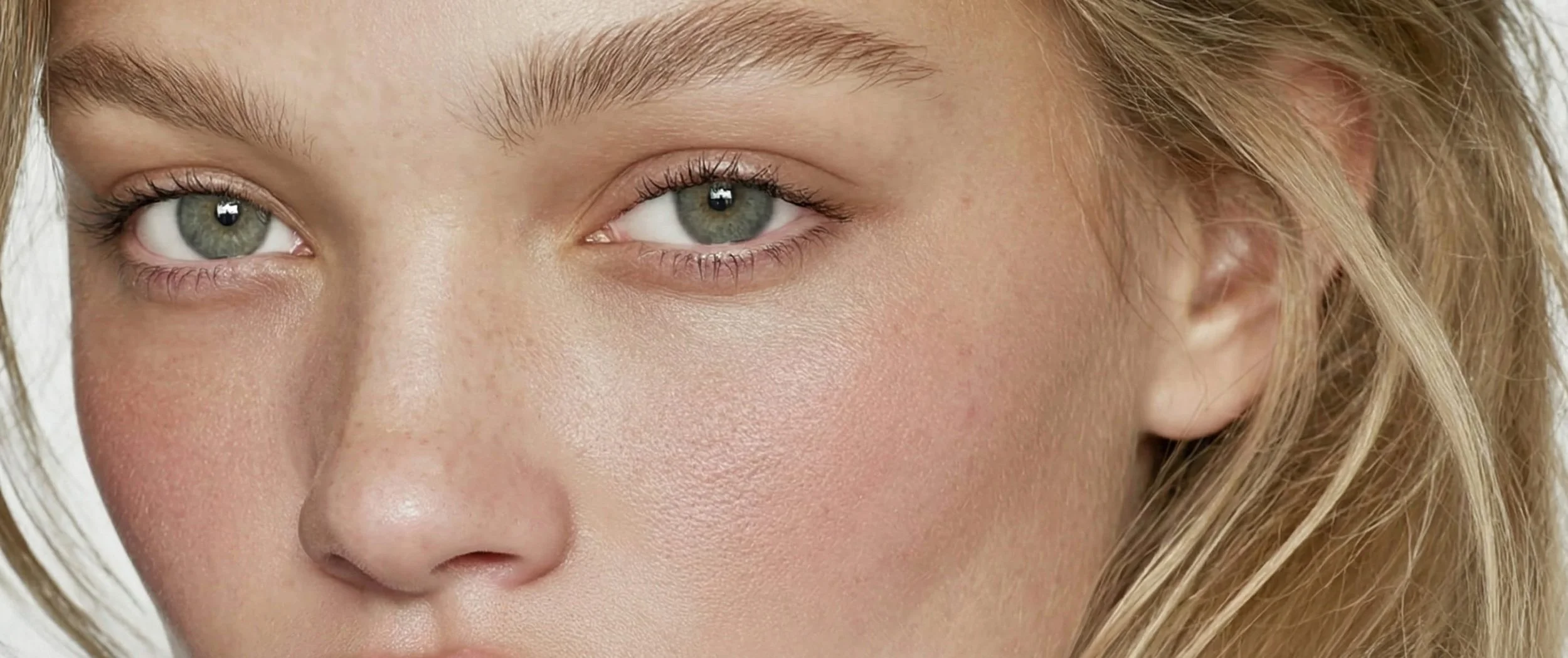
"Blindness" occurs when we focus on the brow in isolation.
The cure is geometry
The only way to cure Brow Blindness is to remove the subjective bias of the trend. This is where technology steps in.
You cannot have "blindness" if you are looking at data. By analyzing facial traits, bone structure, and optical proportions, we can bypass the current trend cycle and determine what actually fits the face.
The future of beauty isn't about following the crowd and regretting it five years later. It’s about finding the shape that belongs to you. It’s about trading blindness for a clear, geometric blueprint.